Tuesday, June 30, 2015

(PART 1) MADAGASCAR-THE HIDDEN LABORATORY OF NATURE


PART 1
COLONIAL BACKLASH & THE FIELDS BEYOND

Several years ago, I knew a charming accountant of Indian origin who came from Madagascar. Her ancestors were probably 'jahajis'-- or immigrants who left India by ships to seek gainful work in distant lands. Women immigrants, by the gender specific nomenclature of Indian vernacular, were 'jahajins' or 'women of the ship'. My linguistic author friend Peggy Mohan beautifully captures the cultural diaspora of these 'jahajins' in her English novel of the same name. Replete with Bhojpuri phrases mellowed by the pidgin-creole linguistic influences of the far off Caribbean, 'Jahajin' could easily be the story of a large number  of Indian settlers not only in the West Indies, but also in Mauritius, Seychelles, Maldives, Africa and of course, Madagascar.   

But my  'Jahajin' friend from Madagascar did not know a word of Gujarati--the language of her ancestors, though she spoke French, the lingua-franca of Madagascar, fluently. I was intrigued to learn that her aunts and grandmothers, very much like the women of 'Jahajin', had left their remote villages in Saurashtra on small sailboats more than a hundred years ago to seek opportunities in this French island, then known as Malagache. Most of them took up menial jobs, some became small time traders and a few even competed with black Africans to work as labourers on agricultural estates of this large island. Lives of a few enlightened women like my accountant friend have since changed dramatically. She today works for a chartered accounting firm in Singapore and her clients represent a large multi-national conglomerate of German origin. Many others, the Gujarati Khojas, Ismailis and Daudi Bohras have prospered in trade, but for many others, mostly illiterate, life is still a daily struggle.

Human Machines--Man drawn Rickshaws in Madagascar 

As a nature enthusiast, my interest in Madagascar was second only to places like the South American Rain Forests, the Galapagos or perhaps Borneo. So an opportunity to spend a couple of weeks in this pristine island was hard to resist. As a writer of sorts, I was also keen to get a close feel of the people and places of this unknown land. 

My knowledge about Madagascar was limited to what my accountant friend had told me. Later, I chanced to see the TV series on Madagascar made by BBC and narrated by David Attenborough. Admittedly, it is impossible to create in a static blog, the sheer magic of Madagascar's unique wild life, as depicted in this wonderful three part documentary, which must have taken several months or maybe years to complete.

Geologists tell us that several million years ago, when the mainland Gondwana commenced its shift east-northwest towards what is now India, a large piece of land broke off and formed the present island of Madagascar. This separation from the mainland allowed Madagascar to evolve its fauna and flora in a manner uniquely different from the mainland Africa or Asia. Madagascar on one hand has no large predators or apes and on the other, it is endowed with its own  evolved species of lemurs, chameleons, birds, flora and trees not found anywhere else. It is indeed a unique laboratory or observatory of mother earth and nature.

One of the Succulent Plant Species at Arboretum d'Antsokay in South West Madagascar

We arrived at Antananarivo, the capital of Madagascar completely exhausted from a long flight via Mauritius. Antananarivo airport reminds you of small Indian airports as they existed in the eighties and the nineties. Ditto the town, though Antananarivo does have its own prosperous localities complete with neat shops, food stores and recreation parks. A bird's eye view of the city from top of a hill, including the artificial lake Anosy and the Mahamasina stadium actually looks beautiful.

Antananarivo- The Capital of Madagascar

But suburban areas outside the downtown are made up of shanty structures and nondescript wooden shacks with a few shops or food stalls here and there. As in India, tourists, irrespective of the colour of their skin, are perceived as highly privileged, gullible people. On arrival, we were handed out statutory warnings not to venture into the streets un-escorted, to 'never-ever' loiter outside after dark and to never attempt taking pictures of the royal palaces. Discarding these somewhat colonial perceptions, we promptly found ourselves surrounded by a motley group of locals as we stepped outside the hotel. But they were a harmless lot, curious to know where we came from and keen to explore possibilities of acting as our local guides (of course at a nominal cost, to be settled preferably in US dollars). Language was a problem as they knew very little English and their French accent was difficult for us.

A Local Butcher Selling his Wares in Antananarivo

Majority of migrant population in Madagascar is a mixture of Austronesian, Bantu, Indian, Arab and Somali settlers. Add to these the numerous persons of mixed blood originating from the colonial British and French ruling class.

Nothing Like A Free Ride on Mom's Back: A Hen with her admiring audience in Antananarivo

From a mere 5 million in 1960, the population in Madagascar has grown by 450 percent to 23 millions in the last 55 years, with a low GDP rate of 2.4 percent. Contrasts in Antananarivo are to be seen everywhere, from well stocked food stores to beggars seeking to scrape a meal somehow.

A Man Pulled Rickshaw Behind a Limousine on a Street in Antananarivo

From the neat downtown you can actually touch the underprivileged, all pervasive ghost town. Once you cross the urban boundary, you are amidst rich vegetation surrounding the bright green rice fields, which offer  a glimpse of one aspect of the country's rich avian diversity.

Children Playing Hopscotch Across Paddy Fields near Antananarivo

Water birds in and around rice fields are easy to spot. During our sojourn we immediately snapped the dark grey morph of the Dimorphic Egret. It exists in grey as well as white morph and is endemic to Madagascar (it extensively breeds here), though it is also seen in the nearby Comoro islands, Seychelles and the coastal belts of Kenya and Tanzania.

The Grey Morph of Dimorphic Egret (Egretta dimorpha)

We spotted the white morph several days later. Experts are of the view that the Dimorphic Egret is a close relative of the Little Egret which is more universally distributed.

The White Dimorphic Egret- Near Antananarivo

In a country of rice eaters where an average person eats over 100 kg of rice every year, productivity in rice fields is of vital importance. Once a net exporter of rice, Madagascar today imports 20 percent of its requirements. This deficit is attributed to poor productivity in rice fields, lack of modern agricultural methods and also, naturally, to sharp increase in population. Much of the cultivatable area lies in the mountain highlands terrains where terrace method of rice cultivation is prevalent. On roads leading out of Antananarivo, you see rice fields grown in narrow terraces along the road. On one such stretch, we were lucky to see a solitary Madagascar Squacco Heron (often also known as Madagascar Pond Heron), a stocky white heron with a characteristic blue bill.

Madagascar Squacco Heron (Ardeola idae)

Madagascar Squacco Heron is an endangered bird that breeds in Madagascar and the surrounding islands. Not more than a few thousand birds survive, due to as rapid erosion of habitat and lack of conservation efforts. Our guide tells us that once upon a time, Magagascar Squacco was as abundant in these wetlands as its cousin the (European) Squacco Heron. Sadly,not any more.

Talk of rice fields and can a kingfisher be far away?. Easily the most adorable bird of any respectable wetland and a darling of all bird photographers, kingfishers exist in more than 90 'avtaars' all over the world. What we had in front of us was a gorgeous Madagascar Kingfisher, a worthy member of the family and endemic to the island.

Madagascar Kingfisher (Alcedo vintsiodes)

The Madagascar Kingfisher is closely related to the Malchite Kingfisher found all over the African mainland. During the course of our travel, we were also to see the Madagascar Pygmy Kingfisher, the other kingfisher commonly found in Madagascar.
  

Madagascar Wagtail (Motacilla flaviventris)

We were to learn that most common wetland and garden birds of the African mainland have endemic Malagiche equivalents with clearly different distinctive features. Likewise, we have a Madagascan Hoopoe and a Madagascar Magpie Robin, both endemic to the island.

Madagascar Magpie Robin (Copysychus albospecularis) with Broader White on Wings

The chirpy grey wagtail of Africa turns up here as Madagascar Wagtail with a white breast and a prominent black necklace around the neck, the Oriental White Eye here is the Madagascar White Eye, endemic to the island and identified quite easily with its very prominent white around the eye.

Madagascar White Eye (Zosterops maderaspatanus)

As we turned back to the hotel, a strange, peculiarly shaped black bird flew over us. This was the Hammerkop, seen commonly in Madagascar as well as in mainland Africa.


Hammerkop( Scopus umbretta)

Hammerkop derives its name from its anvil shaped head and a long beak and is also sometimes named as the Anvilhead. The bird, unlike other birds, participates in strange rituals and builds a very large nest which can be as much as 1.5 metres in diameter. It is made up of ten thousand or even more sticks. It is a 'compulsive nest builder', making upto 2-3 nests in a year, not all of which are actually put to use. Because of its strange appearance and peculiar habits, Hammerkop is regarded as an evil bird in Africa as well as in Madagascar where its presence near a house is not very welcome. Several traditional stories exist about misfortunes resulting from destroying an Hammerkop's nest. Amongst African tribesmen, it is believed that the destroyer gets struck by lightening while in Madagascan folklore, as narrated by Fox Leonard in his book 'The Traditional Poetry of Madagascar', destroying the nest could result in leprosy and other ailments. Thankfully, these beliefs provide a certain degree of protection to this harmless and highly social bird whose abandoned nest provides shelter not only to homeless birds but also to many small animals.
(to be continued)
(Part 2: The Land of Chameleons and Lemurs)
 
Jitendra Bhatia
copyright 2015 Jitendra Bhatia
jb.envirotekindia@gmail.com


Tuesday, May 12, 2015

JAISALMER-DAYS AND NIGHTS OF THE DESERT

The Magic of Sand Dunes

Born not too far away from where the sand dunes begin, I could say that I have a little bit of desert in my blood.  My early childhood memories were made up of  sand dunes, arid bushes of keekar, ber and the bitter-sour fruits of dansra. Catching a teetar (grey francolin) underneath a  semi spherical  basket was a favourite pastime with the older boys. Bajra seeds were laid out below the propped basket to entice the unsuspecting bird, that was invariably set free after a little bit of harmless fun, or even earlier, if an unapproving elder happened to be passing by.

Grey Francolin

 We were a village of strict vegetarians and meat eating was taboo, though on one occasion, an uncle of mine  dared to cook mutton on a slow fire in his backyard. In the fields, choicest bean-like fruits that hung from the tall thorny bushes were reserved for the camels, who deftly nibbled at them, carefully avoiding  the thorns. These were khokhas  which had a flat, slightly acrid taste and once inside you, caused flatulance in decibels to the power of n. Domesticated camels roamed free, but had their front feet tied with a rope, so that they did not graze too far away.

Domestic Camel with its Front Feet Tied Up

Despite so many years spent in different parts of Rajasthan, this was only my second  trip to Jaisalmer. The first one had been with my family.After a gap of barely three years, sand dunes of Barna had enticed me once again. This time I was with Adesh and his 'Nature India' team.
   
As we travelled from Pokhran to Jaisalmer, the dusty terrain brought back a number of  random images, long forgotten, from my childhood. In a way, Jaisalmer was the land of my ancestors, who, several centuries ago,  moved from Rajasthan to Lahore in search of a livelihood. My grandmother, with a trace of pride, often reminded  us that we were warrior Rajputs and not Punjabis. The adjunct 'warrior', though, was a bit of a misnomer. In reality, our ancestors, the Bhatis, were court singers who performed in front of captive audiences. I learnt from my mother that her maternal grand-uncle was a full time singer who also excelled in the popular dance 'swaang' dressed as a woman. In distant rural Bihar, they call it  'Chhokra Naach' or 'Boy Dance'. 

On my first visit, as we approached the outskirts of Jaisalmer, a familiar sense of belonging had overtaken me. As an urban Satyajit Ray fan, I also remembered several mesmerising images from the movie 'Shonar Kella' (The Golden Fortress). Simple sketches in coloured crayons, bright courtyards embellished with peacocks and yes-- the unforgettable sight of the metre gauge train with Feluda chugging across the desert at midnight. Expectations soared high as we entered the outskirts of the city. But the first sight of Jaisalmer filled us with disappointment and a touch of sadness. The town was dusty, uneventful and nondescript, like any other small town of Rajasthan.

Approaching the Jaisalmer Town

The magical Golden Fortress, made of the famed yellow stone of Jaisalmer, is as deceptive as the 'chhokra naach' or the 'swaang' that my great maternal grandfather once danced. Like the Hawa Mahal of Jaipur, the Golden Fortress is only a beautiful façade. There is nothing worthwhile behind it. If anything, the backside, or the reality behind the mask is crass, very commercial and jolting, somewhat like a make-believe set being constructed in the backyard of a film studio.

The Beautiful Facade of 'Golden Fortress'

As with the fort at Chittorgarh, the Jaisalmer 'Kella' too is a 'living fort' with dwellings, dirty pathways, dumps of garbage and unkempt shops & stalls inside its boundary. As a tourist, you are better off clicking the majestic yellow-golden structure from outside and believing in its grandeur, instead of tearing the mask and witnessing the entrails on the other side. In my view, more than the Fortress, a trip around the famed Hawelis of Jaisalmer (particularly Nathmalji Ki Haweli) can certainly be more rewarding and worthwhile.

Nathmalji Ki Haveli

Thankfully, this time over, we were not in Jaisalmer for sight-seeing. As our vehicle turned left, away from the hum-drum of the city, the familiar sight of undulated sand dunes, 'aak' shrubs and thorny bushes of wild berries sprang into view. In the distance, a row of windmills turned their giant blades menacingly. It is learnt that the windmills do not auger well for the terrain and under their influence, the beautiful undisturbed sand dunes are already turning into flat stretches of sand and dust.

On our way to the hamlet of 'Khuri', a large, unfamiliar raptor perched on a bush on one side of the road, took off as we adjusted our cameras. Experts in the group considered the possibility of it being a golden eagle, though no one was really sure. Golden eagles do sometimes travel this far from their Himalayan abode in winter but spotting one in this arid terrain is rare, if not impossible. In the silhouette of the evening, a desert fox, resting behind a clump of shrubs, bolted off on seeing us, but stopped several times on its  track to look back, before finally disappearing behind a sand dune. The desert has its own variants of foxes and cats which are endemic to the region. Last winter at Tal Chhapar (in Churu District of Rajasthan), we had chanced upon a family of foxes with three cubs.


Mother Fox

The mother went hunting during the day while the cubs stayed behind, never venturing far from the den and disappearing into the depths of their home at the slightest sign of danger. In the evening, the mother fox returned with the kill of a rat, but the cubs were still too young and hungry for mother's milk. On the fourth day, the entire family disappeared. We were told that for reasons of safety, the desert fox changes its home two or three times before the cubs grow up.

Cubs of Desert Fox Outside the Den

It was almost dark by the time we reached our destination. Our resort, set in the backdrop of golden sand dunes, consisted of a row of tents with a cluster of rooms with a large courtyard in the centre.

A few arranged chairs and a small platform at one end with a harmonium and a pair of tablas placed in the middle, indicated a musical evening of some sort in the offing. A food counter with a provisional bar at the other end completed the scene.

Waiting for the Evening of Music & Dance

While our resort was fairly well organised, we learnt that more than 100 makeshift resorts operate in the hamlets of 'Khuri' and nearby 'Sam' offering  packaged deals for a 2 or 3 day 'Sand Dunes' holiday. Almost every other house of the village has a tourist lodge of dubious stature in winter. According to one local, the breathtakingly beautiful giant sand dunes used to be   upto 60 metres in height at one point of time. Today they are, sadly, mere shadows of that majestic past, carrying deep in their guts, an unspecified junk of broken beer bottles, metallized plastic 'namkin' wrappers and hordes of empty 'bisleris' recklessly abandoned. Most of the tourists who come here have little or no interest in wild life or nature and come to the desert solely for revelry, food, drink and fun. Environmental impact of these mushrooming resorts (not always with minimum optimal arrangements) on the fragile ecology of the adjoining Desert National Park is a question no one wishes to answer, as long as the cash boxes keep ringing.

How Long Before They Vanish?

As a  vegetarian meal under the stars got underway, the musicians on the dias started tinkering with their tablas and the harmonium. A young boy with miniature cymbals provided additional support to the beats. Starting with the mandatory 'Padharo Mhare Des' (Welcome to my country!), the robust singer moved on to some local semi-classical songs which were quite well rendered. This was followed by the entry of a male dancer  from the wings. Reminiscent of  the 'Chhokra Naach', the dancer was dressed and heavily made-up as a woman in traditional Rajasthani attire. As the evening wore on, the dancer performed a number of items, including the traditional 'kalbelia' (snake dance), dancing on hot embers and manoeuvres while balancing a number of pitchers on the head. The audience generously clapped.

Male Dancers Dressed as Women

 I remembered that during the last visit, some of us had been dragged on to the shop-floor by the dancer and a colourful, energetic number had been performed with active audience participation.

The Desert National Park is one of the larger wildlife parks of the country covering an area of over 3000 kilometres but regrettably, little has been done to preserve the sensitive eco-system of the park. As with many other parks like Sariska in Rajasthan, and Tadoba in Maharashtra, a road, with regular traffic of vehicles and buses cuts across the park. The park's most spectacular inhabitant, the greatly endangered Indian Bustard is gradually getting pushed out into the interior core zone of the park. Maharashtra (Nannaj) and Kutch in Gujarat have already lost nearly all its bustard population. As things stand, this unique species (ironically the state bird of Rajasthan),  is also destined to be wiped out from its last sandy abode, unless appropriate preservation measures are taken on war footing. We learn from Adesh that more than protection, breeding of this extremely shy bird is an issue preventing increase in numbers. During the last trip, we had seen a number of bustards, some of them close to the dwellings.Three years ago, if you drove along the road bifurcating the park early in the morning before the first bus made its noisy journey, you were sure to get a sighting of a couple of bustards at more than one location. Sadly, not any more. Within a matter of 3 years, spotting a bustard has become that much more difficult.

The Great Indian Bustard-- Facing a Grim Future

This time over, on our first morning at the park, we slowly moved in our jeeps with the first rays of sun emerging from behind the sand dunes. Graceful chinkaras, a flock of bimaculated larks blending with the dull ground and a sole long legged buzzard on top of a thorny tree completed the all too familiar desert scene.

A Chinkara in the Desert

Our search for the Great Indian Bustard had just begin, when a speeding milk van overtook our jeep and recklessly hit a chinkara trying to cross the road. As the animal fell down, the van sped away before we could stop it. The chinkara had been fatally hit and withing seconds, it collapsed in the middle of the road, stone dead.

The audacity of the whole act had shaken us up.We informed the forest authorities about the accident, but the guy at the other end of the phone line was sleepy and outright bored. There was nothing more that we could have done.We decided to drag the carcass of the dead chinkara away from the road, so that it did not get run over by another speeding car. 

News of a freshly killed animal spreads fast in the desert. Sure enough, within a few minutes, there were vultures circling the air space above the dead animal. As our presence was a deterrent for them, we moved away to a vantage point with our cameras.

The first to arrive were a pair of Egyptian vultures with a juvenile.   


A Hovering Egyptian Vulture

They were followed by Eurasian Griffons who promptly pushed away the three smaller egyptian vultures to the side line. It was interesting to see that raptors as well as animals descended on the fresh carcass according to a hierarchy system based on might and strength. Anyone trying to break the pecking order was promptly shooed off. As the morning wore off, we got a close glimpse of a pair of Punjab Ravens gorging on the juiciest parts of the carcass and the eyes. The evening was to attract foxes, wild cats and even eagles to the same spot.


Punjab Ravens feasting on the Dead Chinkara
It was ironical that the tragic death of the chinkara was now providing us an opportunity to witness and capture the raptors of Jaisalmer at such close quarters.

A Cinereous Vulture  Swooping on the Carcass


The vast area of the Desert National Park encompasses nearly 70 villages and many traditional settlements called ढाणी which have existed for several hundreds of years. Threat to the sensitive and unique eco-system of the desert comes not so much from these traditional establishments, but from the rampant growth of irresponsible tourism and crass commercialisation of human activity in the area. Communities like the 'Bishnois' have lived for long in complete resonance with the plant and animal life of the arid region. They are not only protectors of wild life (remember the ongoing Chinkara shooting court case involving Salman Khan vs. the Bishnoi community) but also worship and revere the 'Khejri' trees abundantly found in the region.

A Stone Hide in the Park

During the last trip, we had gone around the park in a painfully slow and mighty uncomfortable camel cart, just to get a flavour of the local life. Around the park, we had also found a number of circular stone hides, presumably for watching animals and birds at close quarters. Sadly, most of them were abandoned and in a sorry state of upkeep. A local told us that trappers sometimes use these hide-outs for catching the extremely shy sandgrouse which fly and settle in hundreds, completely camouflaged against the sandy background.

Painted sandgrouse are more difficult to locate, as compared to the widely occuring chestnut bellied sandgrouse which fly all over the desert in large flocks.

Chestnut Bellied Sandgrouse- Female

Amongst the other birds endemic to the region is the upright standing Cream Coloured Courser, which is paler than its 'common' counterpart found in Gujarat and elsewhere.

The Upright Standing Cream Coloured Courser

An important part of the food cycle of the desert is the spiny tailed lizard which burrows in flat ground and forms the regulation diet for buzzards, harriers and their young ones. In the nearby Churu, on a flat bushy ground, we had found thousands of burrows of these lizards, while the adjoining trees were dotted with nests of buzzards and eagles, with an endless supply of food right at their doorstep!

Hardwicke's Spiny Tailed Lizard

 The intricate and extremely fagile eco-system of the Desert National Park, with all its birds, animals, reptiles, insects and plant species is unique and fascinating. During the course of the day we saw buzzards, tawny and steppe eagles and falcons.

Laggar Falcon

Sparrow larks sand short toed larks can be seen on the ground almost everywhere in the park, and if you look up, you will always find a couple of vultures soaring high in the blue sky.Two other endemic species we saw were sand lark and  the desert bush warbler. Wolves were abundant once upon a time but have since been hunted down, mainly due to their unreasonable reputation as cattle lifters. In a small 'dhani'', we found the skin of a wolf hung on a tree outside the hamlet. The wolf had apparently killed three of the village sheep.

Our search for bustards almost drew a blank till we ultimately found a group of four birds almost half a mile away. A number of agencies are today working on preservation of the bustards. But the population  shows no sign of multiplication.

As the day drew to a close, we took mandatory shots of the sunset and then  drove past the dead chinkara back to our resort.

The Resort in the backdrop of the Receding Desert

The carcass had already been reduced to a bare skeleton. In another day or two, it would vanish without a trace and the bones would mingle with the bright sands of the desert. As I chanced to look out of the rear window of my resort into the ugly heap of plastic bottles and other trash, I wished these would also vanish as seamlessly as the dead carcass left behind in the desert. While the chinkara, even in its death  had fed the eco-system before becoming 'dust unto dust' with  the winds blowing over the sand dunes, science tells us that plastic waste in contrast stays put endlessly for another eight hundred years or even more.

And a sobering thought rang through my mind-- which out of these two would I rather leave for the next visitor and for myself and for the children, grandchildren and their grandchildren of this fabulous desert wonderland where my ancestors once sang and danced?

 Jitendra Bhatia
From Jaisalmer, Rajasthan, 2015
copyright Jitendra Bhatia
jb.envirotekindia@gmail.com


Saturday, October 20, 2012

BIRDING STORIES FROM MANSAGAR JALMAHAL JAIPUR

A Panoramic View of Mansagar & Jalmahal


Jaipur Mansagar Jalmahal, like so many other spots in the country, is under threat.  Control of the famous palace in the water is now subjudice and the environmentalists are fighting a desperate battle against a  powerful lobby of builders that wants to convert it into a money spinning tourst hub with boat rides, shopping arcade and the paraphernalia. Boating at Mansagar is on the cards. Future landlords have already served a notice on the resident/ migrant birds, animals, insects and the amphibians that throng the grasses, bushes and trees around the edge of the lake. The clock is slowly, but surely ticking and as we say in Hindi, बकरे की  माँ कब तक खैर मनाएगी? If it happens, it will be a sad end to an oasis in this othewise crowded city. A recluse that has never ceased to fascinate the bird and nature lovers alike. For a regular like me, the cemented path around the lake, leading to the ruins of another era is arguably the most beautiful spot in this historical city.

Beautification of Historical Monument by JDA at Mansagar

 When the last migrant has flown away and the placcid surface of the lake is still, save for the quivering, gasping  hoards of fish along the coast, rows of black crowned night herons and cormorants, and the flapping of a stray moorhen, Mansagar still offers streaks of the unusual. A brown crake, a brahminy kite that has lost its way or the blue tailed bee-eaters on the way up north and of course, the resident stars of Mansagar!

Cormorants Lined up at the Water Dining Table at Mansagar

Beginning of the dry season for the resident birds of Mansagar has been good this summer. The rains were plentiful last year, the lake is still full and fish are there for the asking. Black Crowned Night Herons (Nycticorax nycticorax)  and Spot Billed Ducks (Anas poecilorhyncha) breed here and food is so good that a few stray migrants cancelled their return flights almost till Mid May. 
The all too familiar animals of Mansagar are a friendly lot. 

Mongoose at Mansagar


The little mongoose, normally a shy animal, comes out in the open and there are lizards basking in the sun.    

The Lizard at its Artistic Home

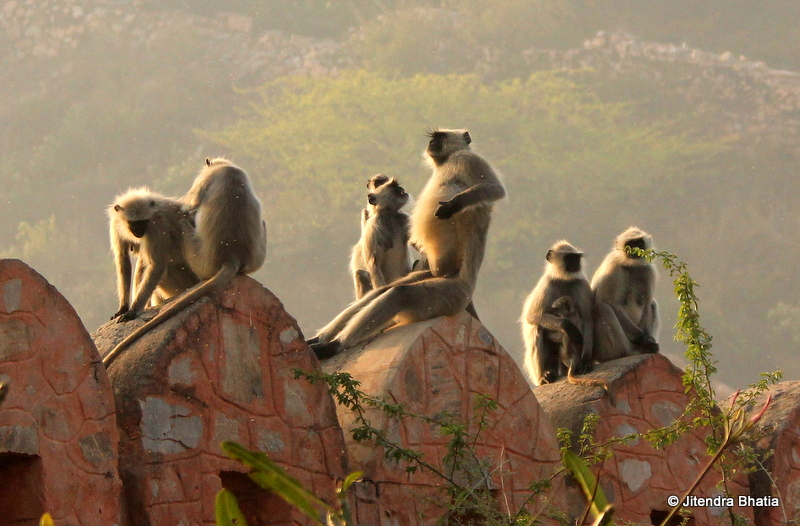
A family of langoors catching the first rays of sunlight make a pretty picture. Everyone is relaxed and the young ones are playful.

Langurs on the parapet of the fortress


Back from exotic birding trips to Bhutan and Sikkim, I still find the ordinary commonplace animals and birds of Mansagar equally fascinating. I share a few shots of the common and the unusual.

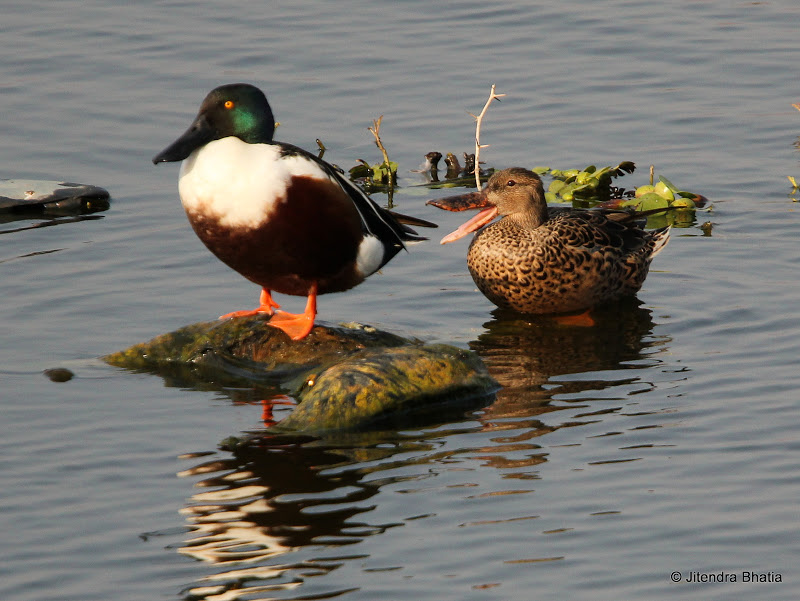
The Couple That Stayed Back For Dinner 
Northern Shovelers (Anas clypeata) descend on Mansagar in large numbers during the winter months and take up most of the shallow waters everywhere. I found a couple that stayed on long after others had left. Here's a Walt Disney cartoon strip featuring Dad and Mom! 

They decided to stay back for the Fish Dinner. Life was plentiful but lonely!


For a while, they were happy on their private island, till Mom started complaining, leading to a face-off.


Dad Tried to ignore her, but her 'yakkity-yakk!' was quite shattering! 


Unable to take it any more, Dad called it a day! Mom, unaffected, carried on relentlessly!

 Size Does Matter
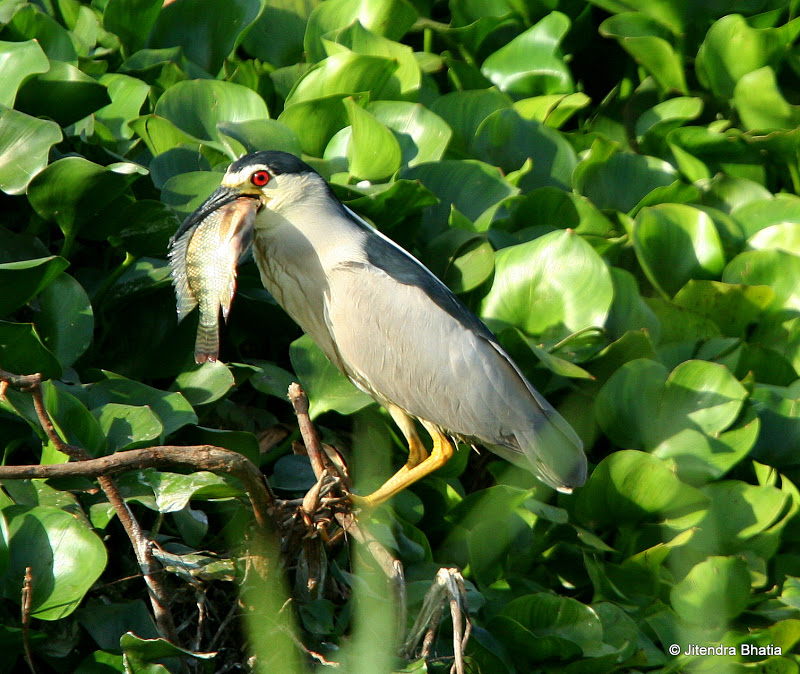
Black Crowned Night Herons are night feeders but a late sunday morning all-fish breakfast is difficult to resist.


This bloke, blissfully unaware of the warning on the board in Hindi, decides to take a plunge into the fish buffet in the water.

Fish are so many that it is difficult to choose!


t

The juicy fish he finally selects is a little bigger than expected and a little difficult to handle. Not to mention the thousand greedy eyes watching your every step!


He finally decides to move to a secluded grove where he can savour the fish at leisure away from intruders!

Learning To Swim
This one is about Spot Billed Ducks and has nothing to do with story of the same name by Booker prize winning author Graham Swift.

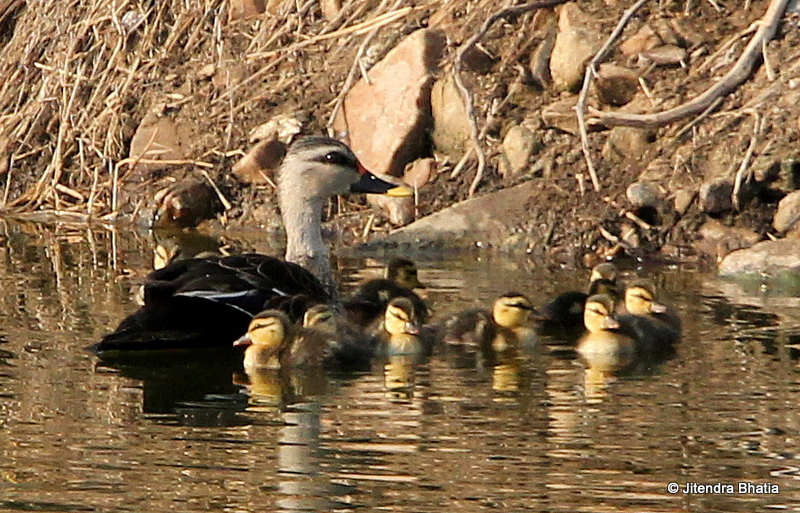
Fleets of Spot Billed Ducks are a permanent feature of Mansagar. They move about freely and do not hesitate to pick up grain meant for pigeons. Small islands in Mansagar are their favourite breeding ground. This one is about a Spot Billed Duck family.

"Come on Lazybones!" Mother duck calls her two day old chicks! " It's time for school!"


"Come on children, follow me closely and be careful!" She seems to say.

"Now the difficult part. We have to go down the slope to the edge of water. Don't rush, just follow me!"


"See how I do it. Move one step forward at a time, OK?"


"Don't be afraid. It's very easy!"

"Now into the water! Don't be afraid. Just do it!!" 

"Don't be a sissy! Just take the plunge!! Whoever heard of a duck drowning in water?"


" That's better! All in?"


 At this precise moment, a sly crow decides to take his chance with a juicy new-born chick. A snipe nearby annxiously watches the action. But the Mother Duck successfully thwarts the evil designs of the crow. And the class goes on....

Everybody in?...  So Company let's onward march one-two, one-two!


 And they happily swam thereafter!

So who says, commonplace birds don't have stories to tell?

At least at Mansagar, Jaipur it's happening all the time!
 Jitendra Bhatia
From Mansagar, Jaipur, May 2012
copyright Jitendra Bhatia